
Throughout history, alabaster has held a singular place in sculpture. Not as a substitute for other stones, but as a material with its own language, capable of engaging in dialogue with form and, above all, with light.
In contemporary sculpture, this quality remains fully relevant and explains why many sculptors continue to choose alabaster over more common materials.
This choice is not accidental. It is based on technical, expressive and sensory criteria that make alabaster an exceptional stone for sculptural creation.
Alabaster as a Sculptural Material
Alabaster is a fine-grained natural stone with a compact structure, traditionally valued in sculpture for its ease of carving, capacity for detail and intimate relationship with light.
These characteristics allow for precise, controlled and progressive work. This is essential in sculptural processes where the direct relationship between the hand and the material defines the outcome.
Unlike harder stones, alabaster does not impose excessive resistance, encouraging a more intuitive connection between sculptor and piece. For many artists, carving alabaster offers a balance between control and fluidity.
A Stone That Works with Light
One of the main reasons sculptors choose alabaster is its interaction with light.
Even in non-backlit sculptures, alabaster captures and diffuses ambient light, generating nuances and depth that opaque stones cannot achieve.
This quality makes it possible to:
- Create volume without exaggerated gestures
- Shape form through subtle transitions
- Produce sculptures that evolve depending on lighting and viewpoint
In alabaster sculpture, light does not remain on the surface. It penetrates the material.
This luminous behaviour is what distinguishes translucent stone sculpture from work in marble or granite.
Workability and Creative Control
From a technical perspective, alabaster offers a significant advantage: versatility throughout the carving process.
It allows for rapid roughing out in early stages and fine, detailed work in later phases.
This adaptability facilitates:
- Adjustments during the process
- Smooth transitions between planes
- Precise finishing without unnecessary material loss
For many sculptors, working with alabaster provides a sense of responsiveness that other stones do not offer.
The Expressive Value of Veining
Far from being a limitation, alabaster veining forms part of the sculptural language.
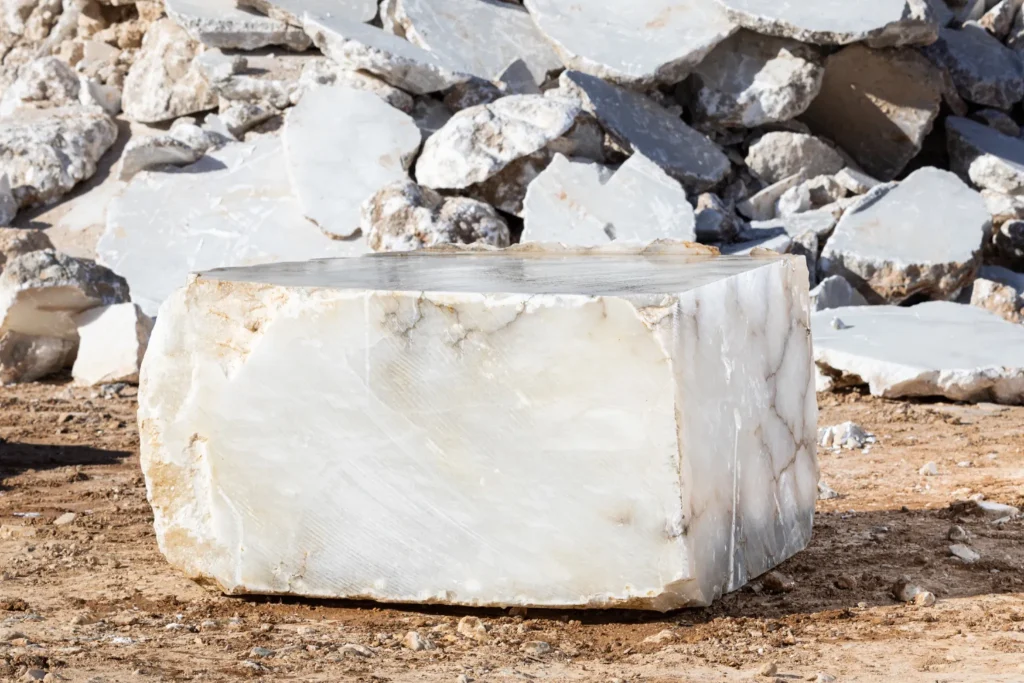
Each block presents flowing patterns, internal clouds and density variations that influence the final result.
The sculptor does not impose form unconditionally. Instead, there is a dialogue with the material. Veining guides cuts, volumes and areas of translucency, becoming an expressive element within the work itself.
In this sense, alabaster carving is not only about shaping mass, but about interpreting internal structure.
Alabaster Compared to Other Stones Used in Sculpture
When compared with other common sculptural materials:
- Marble is harder and more resistant, but less forgiving during the carving process.
- Granite is extremely durable, yet limited in luminous expression.
- Limestone is relatively easy to carve, but lacks the optical depth of alabaster.
Alabaster occupies a unique position: ease of carving, visual richness and exceptional interaction with light.
For artists seeking a translucent stone that combines workability and expressive potential, alabaster remains unmatched.
Tradition, Contemporary Practice and Artistic Creation
The use of alabaster in sculpture connects tradition and contemporary practice.
It has been used for centuries, yet it integrates naturally into current artistic languages, where material presence, light and sensory experience are highly valued.
Companies with a direct and longstanding relationship with the material, such as Arastone Alabaster, provide access to carefully selected alabaster blocks and technical guidance. This allows sculptors to work with a deeper understanding of the stone’s qualities from the outset.
A Stone That Accompanies the Artist
Alabaster does not impose itself on the sculptor. It accompanies the creative process, allows refinement, accepts correction and returns intention in the form of light and matter.
For this reason, beyond trends or fashions, many sculptors continue to choose alabaster over other stones.
Because carving alabaster is not only about shaping material. It is about understanding and working with its internal light.